KEWI Secures Implementation Funds for AfDB-Funded National Urban Water Supply and Sanitation Program
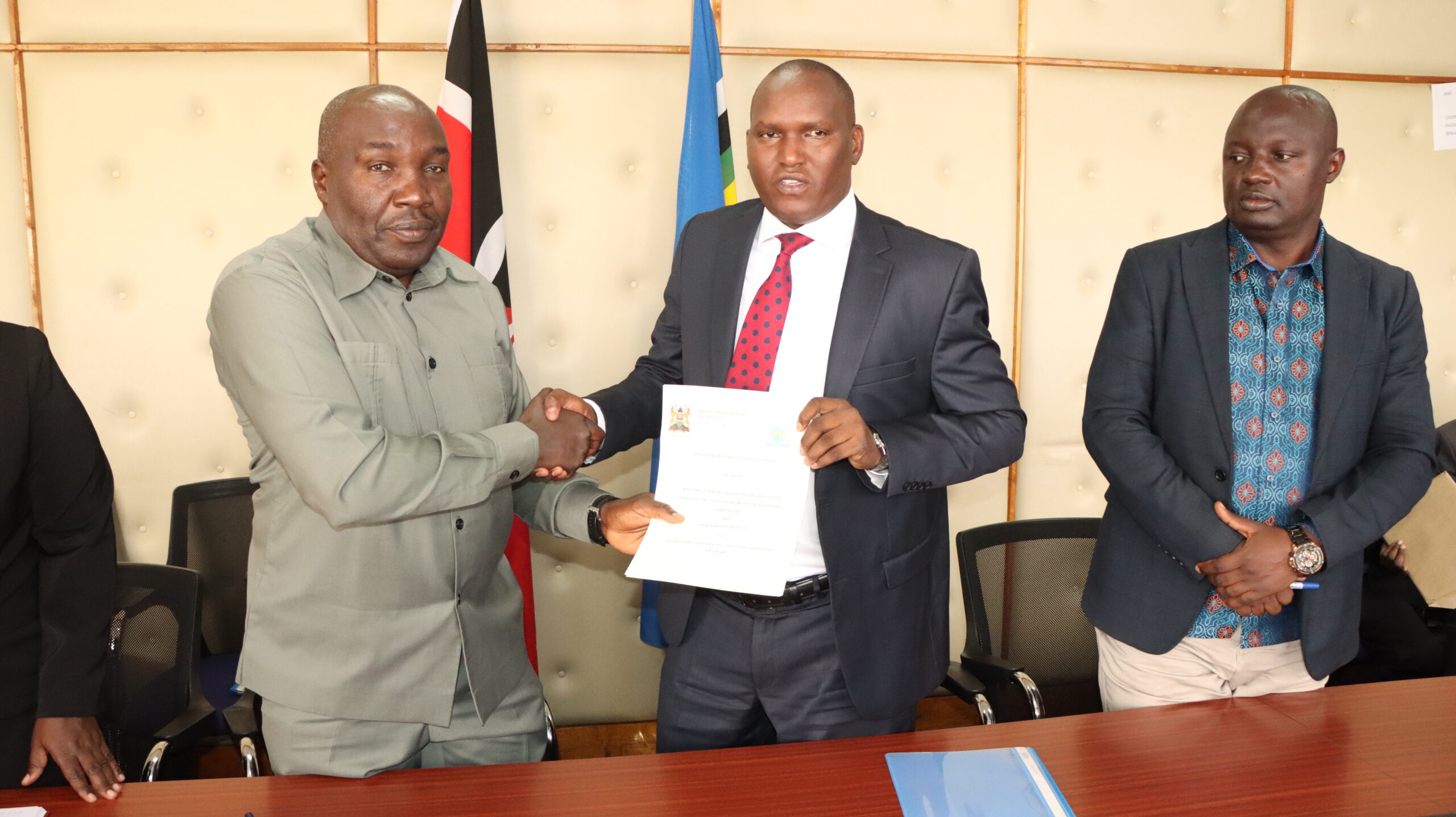
Kenya Water Institute (KEWI) is set to receive 1,992,230 Euros as part of the funds advanced to the Government of Kenya (GoK) through the Ministry of Water, Sanitation and Irrigation by the African Development Bank (AfDB) through the National Treasury towards the costs of the implementation of the National Urban Water Supply and Sanitation Program. This was confirmed today when Director/CEO Dr. Leiro Letangule, EBS, on behalf of KEWI, and Principal Secretary, State Department for Water and Sanitation, Julius Korir, CBS, for the Ministry of Water, Sanitation and Irrigation, signed a Program Implementation Agreement (PIA) for the aforementioned program at Maji House, Nairobi.
In a ceremony attended by various agencies in the ministry, which will be implementing various aspects of the AfDB-funded program, among them KEWI, Mr. Korir urged all the agencies to take the project with the seriousness it deserves.
“Once the program is effective, you should fast-track the procurement process and ensure that all procedures are conducted transparently and in full compliance with the law. Only qualified and competent contractors will be engaged to guarantee timely completion of works that meet the required specifications,” he said.
As one of the implementing agencies under the agreement, the funds will enable KEWI to refurbish its water testing laboratories, refurbish its water and sanitation innovation hub, undertake research to support sustainable and resilient wastewater management and infrastructure, publish research findings in peer-reviewed journals, and disseminate lessons learnt from the studies in conferences, workshops, scientific forums, seminars, webinars and policy briefs. The funds will also help the institute purchase laboratory equipment, vehicles, and equipment for the water and sanitation innovation hub, support staff capacity development, and host innovation conferences.
In accordance with the loan agreement, the State Department for Water and Sanitation, which is the overall executing agency for the program, shall coordinate and ensure the successful implementation of the program components and, in particular, be the overall coordinator of the program by providing adequate budgetary allocation for Full Resettlement Action Plans (FRAP) and counterpart funding to support operations. It will also establish a program implementation team and steering committee, oversee the procurement process of all goods, works, and services for the program, and coordinate engagements between implementing agencies, the National Treasury, and AfDB. The department will also receive, analyse, compile, and consolidate various program reports for feedback or reporting to the National Treasury or AfDB, ensure that the program forms part of the Annual Performance Contract for the department, and monitor and evaluate the implementation of the program.
KEWI, as an implementing agency, will be responsible for the design, procurement, implementation, handover, and operation of the projects under its mandate for sustainability. Further to its other obligations, the institute shall ensure that the projects under its implementation comply with environmental and social safeguards as well as the bank’s procurement requirements, financial management, and controls, among others.
While acknowledging the assignment ahead, Dr. Letangule was categorical that the institute will ensure proper records are maintained for ease of inspection and auditing by relevant authorized oversight bodies and that it will provide technical support and capacity building to county governments and water service providers within the project area as may be requested.
“At KEWI, we shall ensure that we have done all that is required of us to ensure timely implementation of what is part of our assignment and ensure that the overall program is a success,” he said.
The National Urban Water Supply and Sanitation Program, a Kenyan initiative that seeks to improve access to safe and reliable water supply and sanitation services in selected towns across 16 counties, aims to ultimately benefit over 5 million people with improved water access and better sanitation nationwide. The program is in line with the National Water Policy of the Ministry of Water, Sanitation and Irrigation under the National Water and Sanitation Investment Plan (NAWASIP), which was drawn from the plans of the county administrations. With the original funding request submitted by the GoK to the African Development Bank for the program, amounting to 219 million Units of Account and covering the construction of drinking water supply and sanitation systems in 41 towns, failing to materialize due to constraints on the available fiscal space, the entire program could not be financed and was thus revised to 157.4 million Euros. This will cover the present program, which has been designed as the first phase of the overall program, and will support 24 sub-projects in 21 towns covering 16 counties.
The program is aligned with the Kenyan Government’s development priorities as defined in Kenya’s Vision 2030 and its operational priorities under the Bottom-Up Economic Transformation Agenda (BETA) and the Fourth Medium-Term Plan (MTP-IV 2023-2027). It is also in line with Priority I of the Country Strategy Paper 2024-2028, which is to stimulate private sector development through infrastructure development and policy reforms.
By: Pius Kimani